By Edward Collins
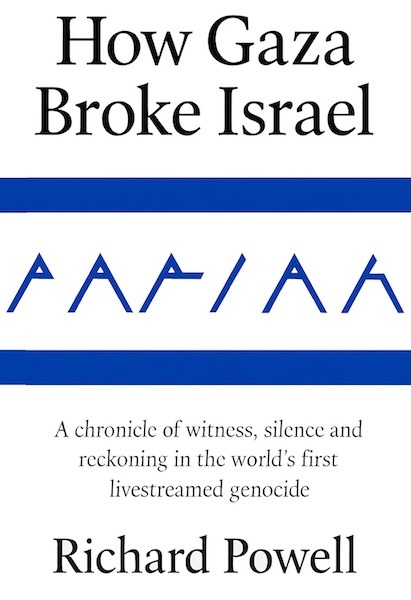
International systems rarely collapse overnight. More often, they erode through visible contradictions. Richard Powell’s Pariah: How Gaza Broke Israel presents the Gaza war as a stress test for what is often called the liberal international order — the network of institutions, treaties and norms designed to regulate state behaviour after 1945.
Powell’s central contention is that Gaza exposed a widening gap between stated principles and applied practice. The war unfolded in full public view, under conditions of unprecedented documentation. As images of destruction circulated globally, institutional responses were scrutinised not only for their content but for their consistency.
The book situates Gaza within a longer trajectory of post-Cold War geopolitics. Powell traces the evolution of humanitarian intervention doctrine, the rhetoric of universal human rights and the gradual expansion of international criminal law. Against this backdrop, Gaza becomes more than a regional conflict. It becomes a case study in normative enforcement.
The blockade of Gaza, in Powell’s telling, formed the structural foundation of the crisis. Restrictions on goods, movement and economic development produced a densely vulnerable civilian population. When large-scale military operations began, the humanitarian consequences were immediate and widely visible.
Powell examines how major Western governments framed the conflict. Statements emphasising Israel’s right to self-defence were often paired with calls for restraint. Yet the asymmetry between rhetorical caution and continued military support became a focal point of criticism, particularly in countries across the Global South.
The International Court of Justice and International Criminal Court feature prominently. Powell details provisional measures, arrest warrant debates and jurisdictional controversies. He argues that once Gaza entered formal legal proceedings, institutional credibility became intertwined with the conflict’s outcome.
The concept of proportionality under international humanitarian law receives careful attention. Powell interrogates how the principle is interpreted when civilian casualties reach high levels in densely populated areas. He suggests that public perception of proportionality increasingly shapes diplomatic legitimacy.
The United Nations itself becomes an object of analysis. Security Council vetoes, General Assembly resolutions and emergency debates illustrate structural limitations within multilateral governance. Powell argues that Gaza illuminated these constraints in stark relief.
Media visibility amplifies institutional strain. Satellite imagery, hospital reports and independent investigations circulated rapidly, often challenging official narratives. Powell contends that in a digital era, discrepancies between visible evidence and institutional language erode trust more quickly than in previous conflicts.
The Global South’s reaction forms a crucial part of the narrative. Governments in Latin America, Africa and Southeast Asia invoked accountability language with increasing clarity. Powell suggests that Gaza reinforced perceptions of selective enforcement within international law.
The prose is measured but firm. Powell does not present his argument as neutral observation. He writes from a position that accountability should be universal rather than discretionary. Critics may argue that geopolitical realities often constrain ideal enforcement.
There are passages where rhetorical intensity approaches indictment. Yet the broader structural analysis remains coherent. Powell situates Gaza within an evolving debate over whether the liberal international order retains normative authority.
As contemporary political analysis, Pariah is ambitious. It links one regional war to the durability of global institutions.
Whether Gaza ultimately proves to be a turning point for the international system remains uncertain. Powell’s contribution is to frame the question explicitly.
In his assessment, the credibility of institutions is cumulative. Gaza placed that credibility under sustained and visible pressure.
Pariah: How Gaza Broke Israel is available in ebook, paperback and hardback editions. Retail purchase information, including Amazon listings, is provided at https://pariahbook.com/, where readers can also download the first three chapters free of charge.