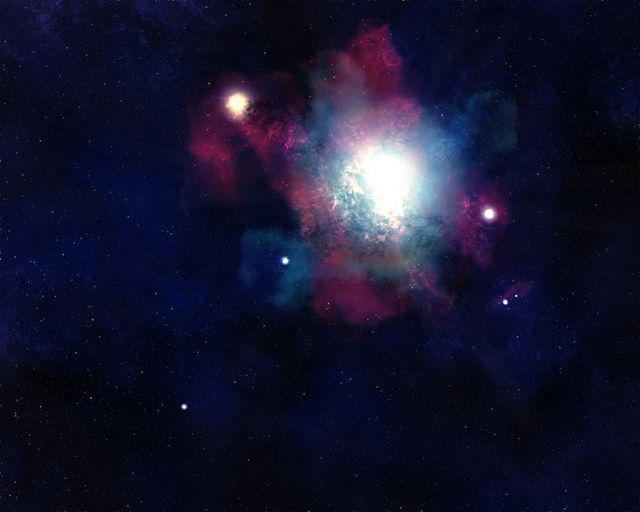
WASHINGTON, September 17, 2026 – A vast cloud of gas and dust glows against the darkness of space in a new image from NASA’s James Webb Space Telescope, offering a detailed look at a cosmic nursery roughly 1,000 light-years from Earth.
The image shows IC 348, a star-forming region in the constellation Perseus. Faint wisps of gas and dust stretch across the picture, while young stars appear as bright spots within the cloud. Some of them even show diffraction spikes from the telescope optics.
It looks serene. The physics is anything but.
In IC 348, cold hydrogen gas is undergoing gravitational collapse to form the dense regions where star formation can occur. This picture doesn’t just show astronomical scenery; it’s capturing a vital step in the process of stellar system formation.
A search for brown dwarfs
Webb’s discovery came about as part of a scientific quest to find and analyze brown dwarfs, which are celestial bodies that form through processes like stars but lack the necessary mass to trigger hydrogen fusion in their cores.
That means brown dwarfs fall into an odd middle ground; they’ve got more mass than the largest planets and less mass than the smallest stars.
Detecting them is tricky because of their relative coolness and faintness in visible light. Fortunately, Webb’s Near-Infrared Camera (NIRCam) picks up their thermal glow right through thick dust lanes. Thus, the capabilities of the Webb telescope become vital while studying these cosmic entities.
The brown dwarfs Webb spotted in IC 348 weigh as little as twice the mass of Jupiter. “Finding objects this small challenges our standard models of how stars condense out of gas,” explained astronomer Catarina Alves de Oliveira. Now scientists are searching for even lighter brown dwarfs to see how low that mass limit can go.
Why IC 348 matters
Star-forming regions act as natural laboratories. They contain a mix of young stars, residual gases, and dust, alongside celestial bodies that didn’t quite make it into full stardom.
By observing IC 348, astronomers can compare star and brown dwarf formation within the exact same neighborhood. This sheds light on a fundamental question: At what point does a celestial body acquire enough mass to begin evolving toward star status?
There isn’t a clear-cut dividing line here; formation environment, mass, and internal physics all play key roles.
Webb’s infrared vision cuts through the murky environment. Dust clouds that would normally hide objects turn transparent to infrared sensors.
A snapshot with a larger purpose
The new image is compelling because it is both spectacular and research-driven at the same time. Not all the bright spots will turn out to be newborn stars, and the faint objects will be hard to classify; astronomers have to correlate the findings with theoretical models and further observations.
Nevertheless, IC 348 provides a unique image that reminds us that star formation is not a completed process which occurred in the faraway past but is currently taking place within the nebula 1,000 light-years from Earth.
Even though Webb’s image might seem to be a painting of the cosmos, it is actually a chart showing objects still choosing their way.