Editor’s note: This story was originally published July 6, 2026 and has been updated to reflect the latest developments as of August 7, 2026.
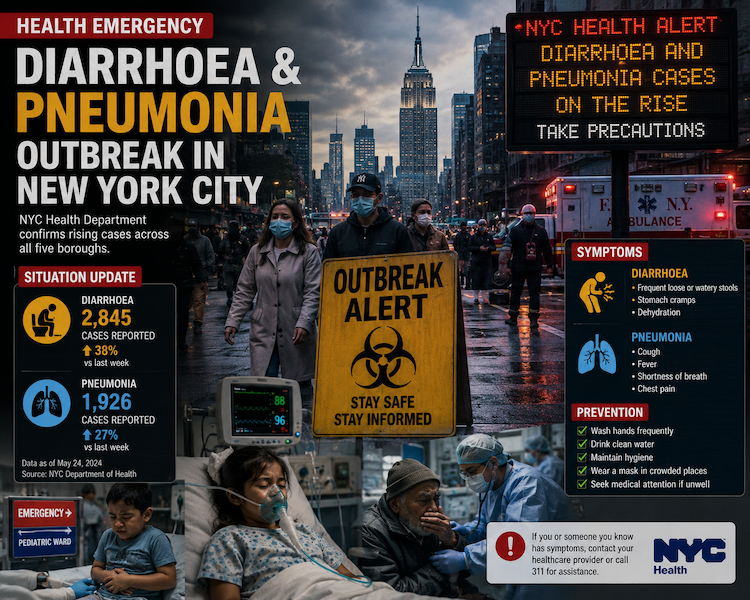
New York, July 6, 2026 – New York public health authorities issued concurrent alerts this summer following a sharp increase in cases of Legionnaires’ disease, a severe form of pneumonia, on Manhattan’s Upper East Side, alongside a rapidly expanding statewide outbreak of the diarrhoea-inducing parasite Cyclospora.
The Legionnaires’ cluster began July 2 in the Upper East Side neighbourhoods of Carnegie Hill, Yorkville, and Lenox Hill (ZIP codes 10028, 10075, and 10128), according to the NYC Health Department. By July 6, the department had confirmed 36 cases and 22 hospitalisations; the cluster continued growing before NYC Health Commissioner Dr. Alister Martin announced on July 31 that it had ended, with the incubation window for new cases having passed. The final toll: 92 confirmed cases, 79 hospitalisations, and 7 deaths, as first reported by NY1 and The City.
Separately, the New York State Department of Health reported 394 cases of cyclosporiasis statewide since May 1 as of July 9 — 273 of them in New York City — according to reporting by NBC New York. Cases kept climbing: NYS DOH Commissioner Dr. Jim McDonald reported 576 statewide cases by July 19, per Spectrum News. As of August 5, the state’s official tracker shows 867 cases for 2026 to date.
Legionnaires’ Disease Cluster
NYC Health Department epidemiologists identified an environmental source — building cooling towers, which use water to cool buildings and can spray a fine, contaminated mist into the air when Legionella bacteria proliferate inside them. Investigators ultimately tested 183 cooling towers across 160 buildings in the affected area, ordering 83 buildingswith positive results to clean and disinfect their systems; all had completed remediation by mid-July.
Municipal Response
Mayor Zohran Mamdani’s administration took the unusual step of publicly disclosing the specific addresses of buildings whose cooling towers tested positive during initial screenings — the first time the city had taken this approach. Officials linked the rising frequency of summer clusters to regional climate shifts toward warmer, high-humidity weather patterns.
Health officials emphasised throughout that the municipal drinking water supply was unaffected. Residents in the impact zone could safely drink tap water, cook, bathe, and operate standard home or vehicle air-conditioning units.
Statewide Cyclosporiasis Spike
New York emerged as a major hotspot for a national surge in cyclosporiasis, an intestinal illness caused by the microscopic parasite Cyclospora cayetanensis. State health officials said the infection causes severe, prolonged, and sometimes “explosive” watery diarrhoea, which can trigger dangerous dehydration if left unmanaged. Other symptoms include severe stomach cramps, nausea, fatigue, and weight loss.
Investigation Status
The CDC and FDA collaborated to track the contamination vector. On July 17, Taylor Farms recalled iceberg lettuce sourced from central Mexico after the CDC and FDA linked it to a multistate outbreak — the most concrete lead identified so far. Like Legionnaires’ disease, cyclosporiasis does not spread from person to person; infection only occurs by consuming food or water carrying microscopic faecal traces of the parasite.
Symptoms and Medical Evaluation
Pneumonia screen (Legionnaires’ disease): high fever, chills, cough, shortness of breath, muscle aches, and confusion.
Gastrointestinal screen (Cyclospora): persistent, watery bowel movements, nausea, and acute stomach cramps.
Because early symptoms of Legionnaires’ disease can occasionally include diarrhoea and nausea alongside respiratory issues, individuals exhibiting an overlapping mix of these symptoms should seek formal medical testing rather than attempting to self-diagnose.
Vulnerable Populations
While otherwise healthy individuals typically experience mild or self-limiting symptoms, both infections pose severe risks to specific groups: adults aged 50 and older, individuals with chronic lung disease or a history of smoking, and immunocompromised patients (e.g., those undergoing chemotherapy or living with autoimmune disorders).